
AI Self-Service Kiosks in 2026: How Intelligent Hardware Is Reshaping Retail, QSR & Healthcare
Bottom line up front: The self-service kiosk is no longer a touchscreen on a stand. By 2026, AI Self-service kiosks are delivering personalized recommendations, processing multi-modal inputs (voice, face, QR, NFC), and running on-device inference without cloud dependency. The global kiosk market is on track to exceed $45 billion — and the businesses deploying intelligently are pulling decisively ahead. Here is what the hardware landscape looks like, and what it means for operators deploying at scale.
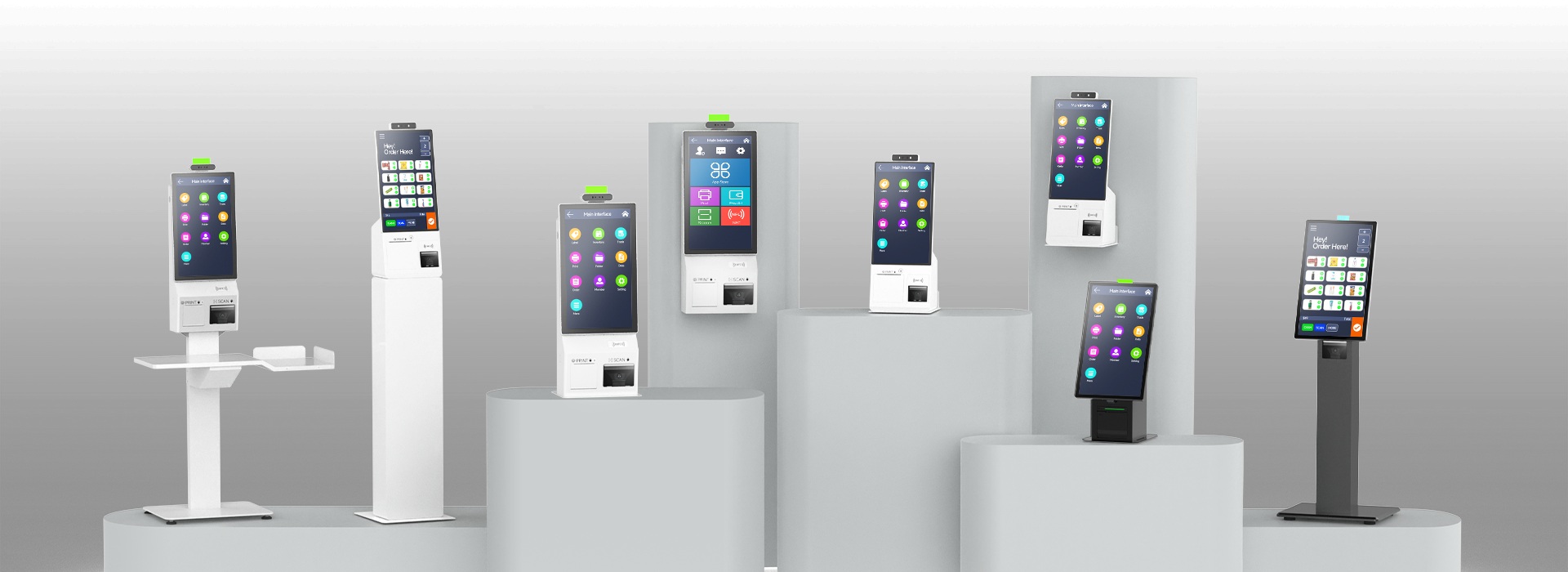
Table of Contents
- The Rise of the Intelligent Kiosk Interface
- Key Industries Driving Kiosk Demand in 2026
- What to Look for in Kiosk Hardware Specs
- Data Privacy and Ethical AI in Self-Service
- People Also Ask: Top Kiosk Questions Answered
- What is an AI-powered self-service kiosk?
- What industries use kiosks the most?
- How much does a commercial kiosk cost?
- What is the difference between a kiosk and a POS terminal?
- How do you manage kiosks remotely?
- Are self-service kiosks replacing jobs?
- How SUNTEK SK Series Kiosks Are Built for the AI Era
1. The Rise of the Intelligent Self-service Kiosk Hardware Interface
The humble touchscreen is evolving. Today’s kiosks are “sleek, sophisticated and packed with cutting-edge features,” according to Kiosk Marketplace — and AI is the engine driving that transformation.
Modern kiosks in 2026 are capable of:
- Natural language understanding: Responding to voice commands in multiple languages
- Computer vision: Recognizing products, verifying cart contents, and enabling face-based loyalty sign-in
- Personalized recommendations: Drawing on purchase history and real-time inventory to surface relevant upsells
- Predictive analytics: Flagging maintenance needs and low-stock situations before they become problems
“Retailers who deploy AI will be on the front edge of redefining the industry, gaining a powerful advantage over the competition,”— Dr. Jason Corso, CSO of Voxel51, University of Michigan (via Kiosk Marketplace).
The shift is not incremental — it is architectural. Kiosks are becoming edge AI nodes: standalone intelligent devices that process data locally, act autonomously, and sync selectively with the cloud.
2. Key Industries Driving Kiosk Demand in 2026
Quick Service Restaurants (QSR)
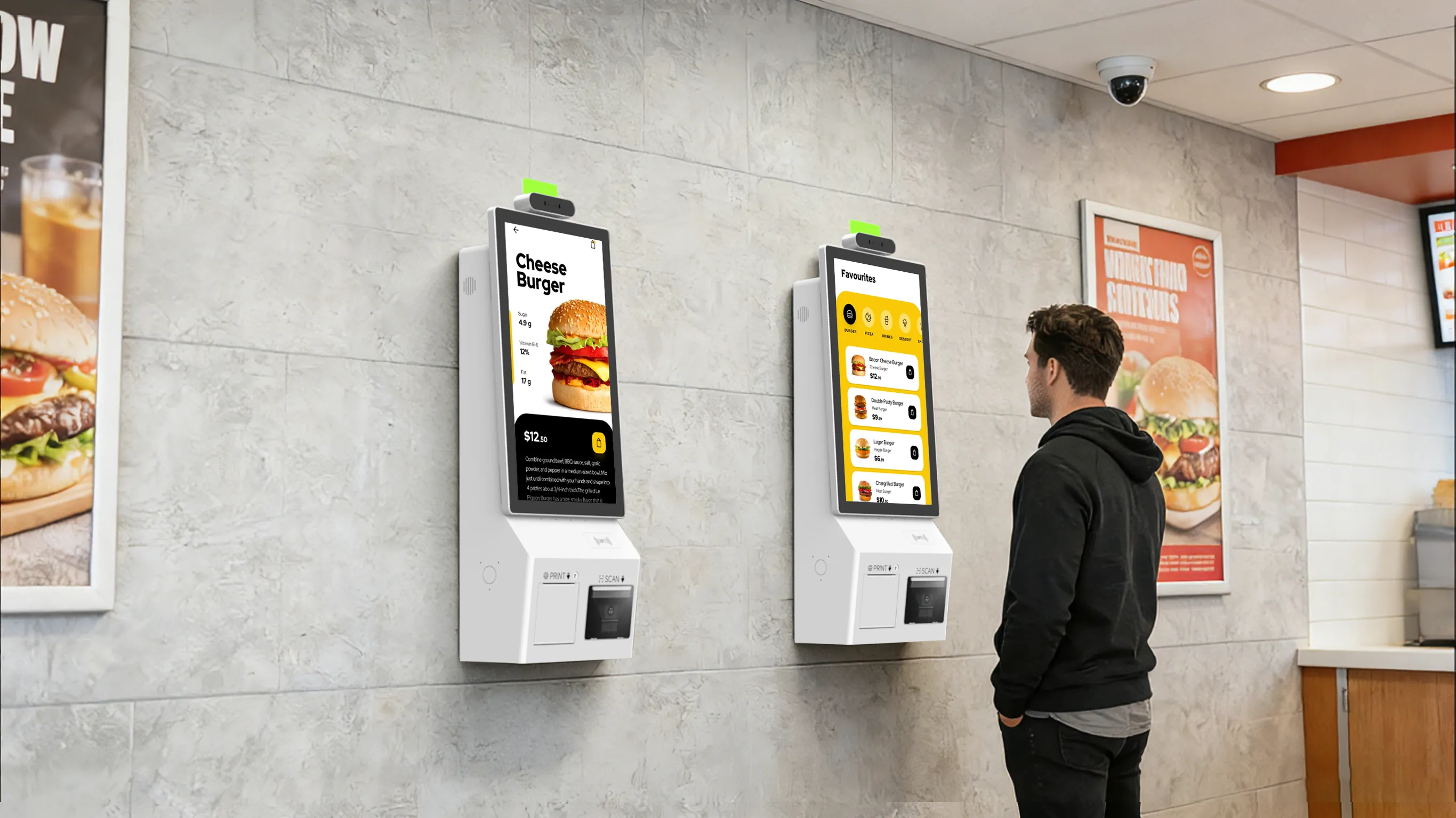
Self-ordering kiosks have become standard in QSR chains globally. Average order values increase 15–30% when customers order via kiosk vs. cashier — driven by upsell prompts and reduced social pressure. Chains that lack kiosks are now at a competitive disadvantage on throughput and ticket size.
Retail & Self-Checkout
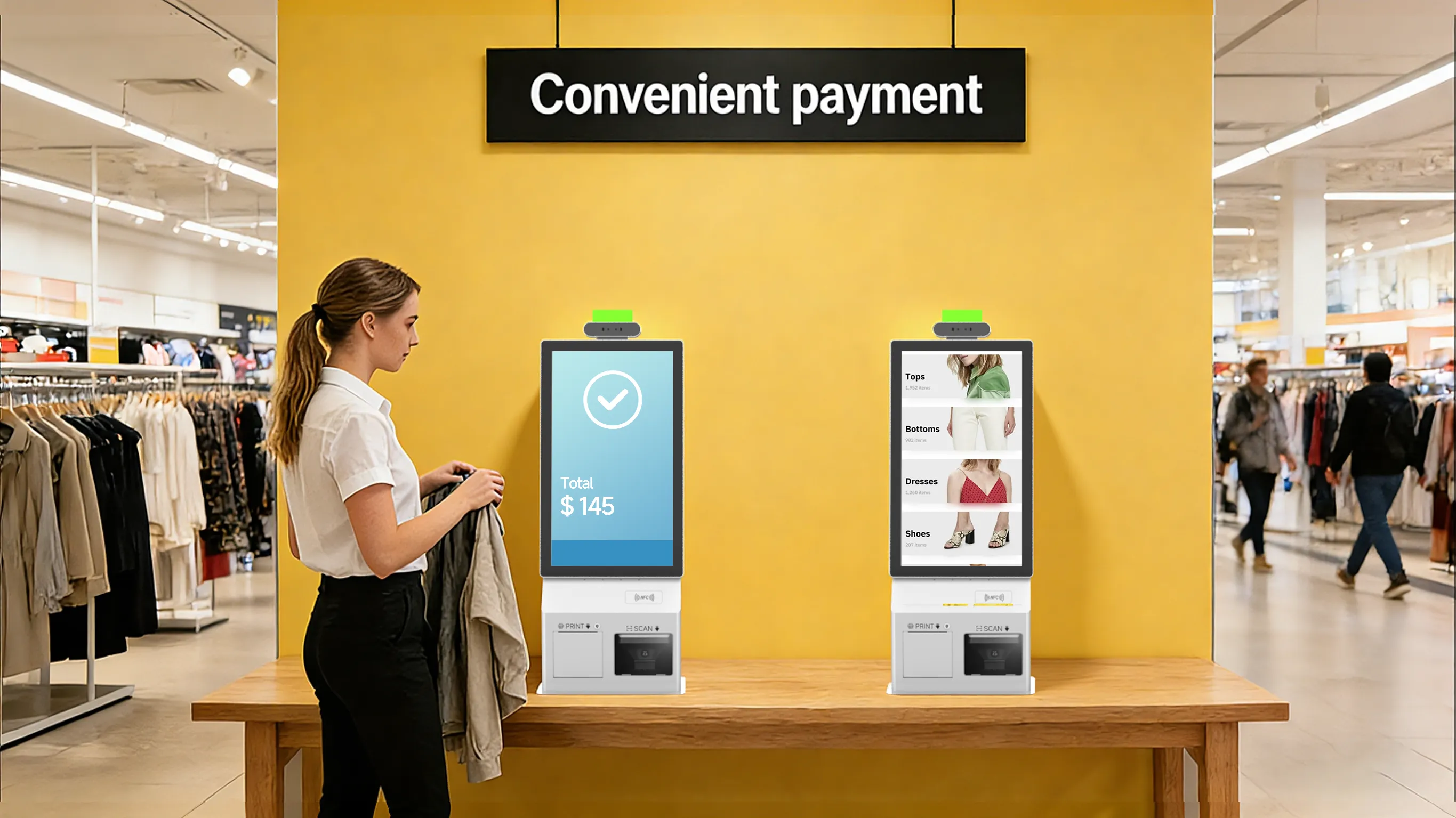
AI-powered self-checkout and product discovery kiosks are shrinking checkout queues while generating behavioral data. Computer vision-based cart verification is addressing the shrink problem that plagued early deployments. Kiosk Marketplace identifies self-checkout as one of the top trending kiosk topics of 2025–2026.
Healthcare
Patient check-in kiosks reduce front-desk bottlenecks, improve data accuracy, and enable contactless intake. Adoption accelerated post-pandemic and continues to grow, particularly in high-volume outpatient and pharmacy settings.
Hospitality & Travel
Hotel self-check-in, airport wayfinding, and ticketing kiosks are now expected amenities. Properties that lack them face increasing guest dissatisfaction scores.
Education
Interactive learning kiosks, campus wayfinding, and student services terminals are expanding across universities and vocational institutions — with particular growth in APAC markets.
3. What to Look for in AI Self-service Kiosk Hardware Specs
Buyers evaluating AI Self-service kiosk hardware should prioritize the following in 2026:
- Processor: Octa-core ARM (e.g. RK3576) — handles AI inference + UI simultaneously
- OS: Android 11 / Android 14 — lower cost, broad app ecosystem, strong MDM support
- Display: 15.6″ FHD, 250 cd/m² min — readable in bright retail environments
- Connectivity: WiFi 6 + 4G fallback — uptime in poor wired infrastructure environments
- Peripherals: NFC + QR + barcode scanner — covers all payment and loyalty scenarios
- Certifications: CE, FCC, RoHS — required for international deployment
- Mounting: VESA 75×75 / 100×100mm — flexible: wall, counter, floor-stand
- MDM Support: Remote OTA + monitoring — reduces on-site maintenance cost at scale
SUNTEK SK1 and SK1-15 exemplify this spec profile: 15.6-inch single-screen Android kiosks powered by RK3568 or RK3576 octa-core processors, running Android 11 or Android 14, with WiFi 6, 4G support, NFC, QR scanner, and CE/FCC/RoHS certification. The single-screen form factor keeps cost-per-unit low while maintaining full AI and payment capability — ideal for high-volume deployments where per-unit economics matter.
4. Data Privacy and Ethical AI in Self-Service
As AI capabilities expand, so do privacy obligations. Kiosk operators in 2026 must navigate:
- GDPR and regional biometric laws: Facial recognition data is regulated strictly in the EU, California, and a growing list of jurisdictions.
- On-device vs. cloud processing: On-device AI inference keeps sensitive data local — reducing compliance risk and eliminating cloud latency.
- Transparency requirements: Customers increasingly expect to know when AI is active and what data is collected.
- Consent and opt-in flows: Personalization features require clear consent mechanisms as standard practice.
Hardware that supports on-device inference — rather than uploading biometric data to external servers — provides the cleanest path to compliance.
5. People Also Ask
Q: What is an AI self-service kiosk?
An AI-powered self-service kiosk is a standalone interactive terminal that uses artificial intelligence — including computer vision, NLP, and machine learning — to deliver personalized, intelligent customer experiences without staff intervention.
Q: What industries use self-service kiosks the most?
Highest-volume deployments: QSR, retail self-checkout, healthcare patient check-in, hospitality (hotel check-in), and transportation (ticketing and wayfinding).
Q: How much does a commercial self-service kiosk cost?
Commercial kiosk hardware typically ranges from $$800 to$$5,000+ depending on screen size, peripherals, and ruggedization. Android-based solutions like the SUNTEK SK series offer lower TCO vs. Windows alternatives at scale.
Q: What is the difference between a kiosk and a POS terminal?
A POS terminal is designed for cashier-operated transactions. A kiosk is designed for customer self-service — larger screen, more durable enclosure, optimized for unattended public operation.
Q: How do you manage kiosks remotely?
Commercial kiosks support MDM software for remote configuration, content updates, monitoring, and troubleshooting. Android kiosks work well with SOTI, AirWatch, or custom enterprise MDM platforms.
Q: Are self-service kiosks replacing jobs?
Kiosks are redeploying labor rather than eliminating it. Staff freed from routine transactions are reassigned to higher-value customer service roles.
6. How SUNTEK SK Series Kiosks Are Built for the AI Era
SUNTEK (Suntek Technology Co., Ltd.) has been designing and manufacturing commercial terminal hardware since 2010, with over 5 million units deployed across 80+ countries.
The SK series is SUNTEK’s dedicated AI self-service kiosk line — single-screen architecture optimized for high-volume, cost-sensitive deployments:
- SK1: 15.6″ FHD single-screen | RK3568 Quad-Core or RK3576 Octa-Core | Android 11/14 | WiFi 6 + 4G | NFC + QR Scanner | CE, FCC, RoHS
- SK1-15: 15.6″ FHD single-screen | compact form factor | Android 14 | WiFi + 4G | NFC + QR | CE, FCC, RoHS | optimized for counter and wall-mount
- SK5: 21.5″ or 15.6″ options | floor-standing enclosure | suited for high-traffic retail and hospitality lobbies
All SK models support:
- Optional peripherals: receipt printer, MSR card reader, fingerprint reader, barcode scanner
- VESA 75×75mm and 100×100mm mounting
- MDM-compatible Android OS for remote fleet management
- On-device AI inference — no cloud dependency for core functions
📌 Learn more: https://www.suntekai.com
✉️ Contact: business@suntekai.com
SUNTEK (Suntek Technology Co., Ltd.) — manufacturer of intelligent commercial terminal devices. Deployments in 80+ countries since 2010. Product lines: Desktop POS (SC series), Self-Service Kiosks (SK series), Mobile POS (SM series), Face Recognition Terminals (FA series), Edge AI Boxes (SA series).