
AI-Ready Commercial Hardware: Building the Foundation for AI Solutions
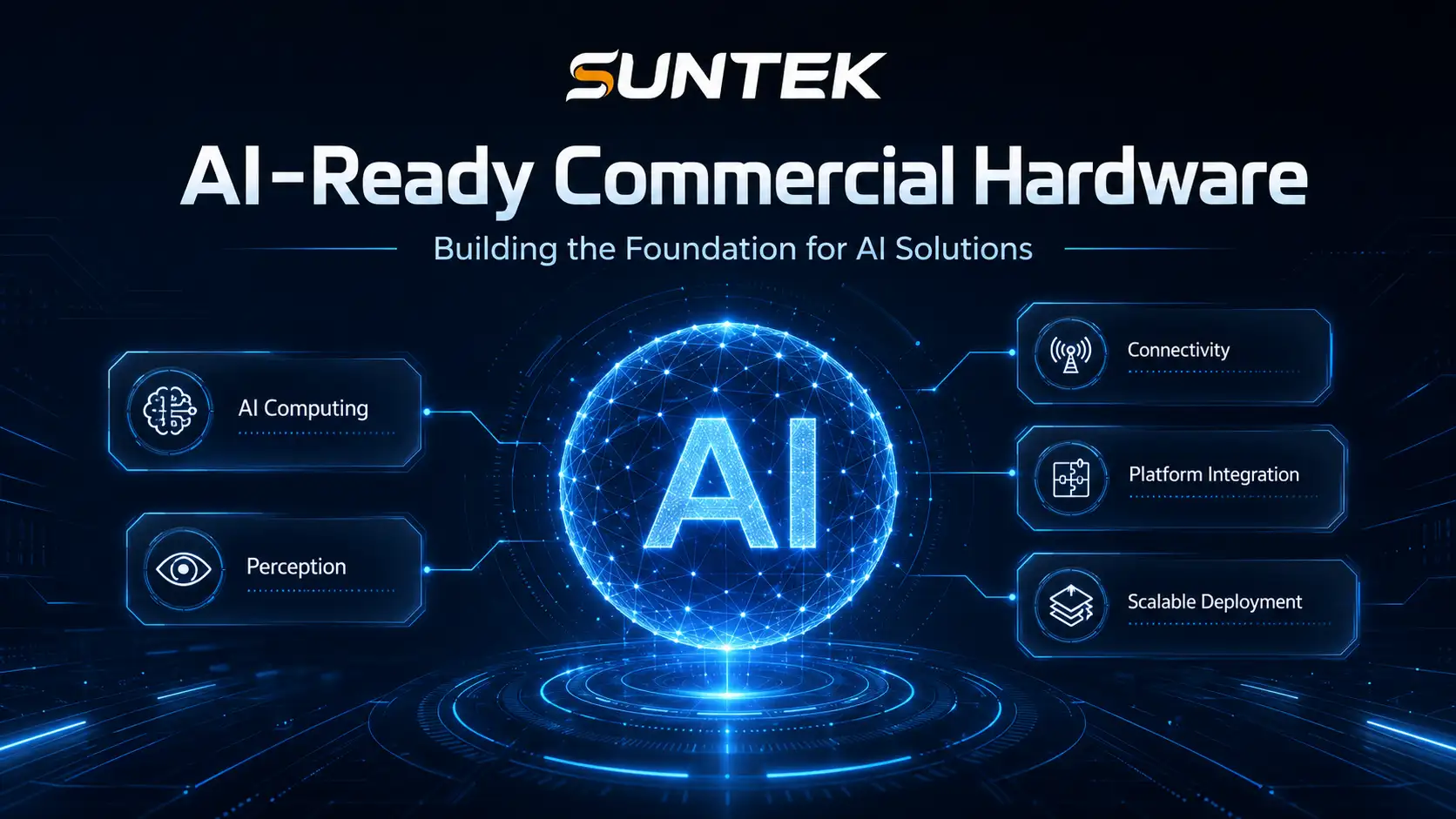
AI is Redefining the Role of Commercial Hardware
Artificial Intelligence (AI) is rapidly transforming industries including retail, healthcare, security, and service automation.
For commercial terminals, AI creates new possibilities:
- More intelligent interaction
- More efficient business operations
- Better user experiences
- Smarter decision-making
However, from the perspective of a commercial hardware manufacturer, AI is not simply another feature that can be added to a device.
The future competition in commercial hardware will not be about who adds AI capabilities faster, but who can build hardware platforms that enable AI solutions to scale in real-world environments.
AI-Ready Hardware Starts Before AI Applications
A successful AI commercial terminal is not created by simply integrating an AI application into an existing device.
It starts from the hardware architecture design stage.
Traditional commercial terminals mainly focus on:
- Processing transactions
- Displaying information
- Connecting peripherals
- Ensuring long-term reliability
AI-ready devices require broader considerations, including:
- AI computing capability
- Data perception capability
- Connectivity
- Deployment scalability
The hardware foundation determines what AI applications can be delivered in the future.
AI Capability Is Not Only About Chips, But Complete Hardware Architecture
An AI chip or NPU provides computing capability, but it does not automatically create an AI solution.
A truly AI-ready commercial device requires multiple hardware capabilities working together.
1. AI Computing Capability
AI workloads are different from traditional applications. Commercial AI devices need to consider:
- AI SoC selection
- NPU/GPU acceleration
- CPU performance
- Memory and storage capacity
- Edge AI inference capability
These capabilities enable commercial devices to support applications such as:
- Computer vision
- Face recognition
- OCR recognition
- Voice processing
- Local AI inference
2. AI Perception Capability
AI needs to understand the physical world. Hardware provides the connection between digital intelligence and real environments.
Vision Capability
Through cameras and image sensors, AI-enabled devices can support:
- Face recognition
- Identity verification
- Object detection
- Customer flow analysis
- Product recognition
For commercial identity and access applications, SUNTEK provides facial recognition terminal solutions for access control, attendance, visitor management, and identity verification scenarios.
Voice Capability
Voice interaction requires:
- Microphones
- Audio processing capability
- AI computing support
These hardware foundations enable:
- Voice interaction
- AI assistants
- Natural human-machine communication
Additional Sensor Integration
Depending on application requirements, AI-ready devices may also integrate:
- NFC modules
- Fingerprint sensors
- Barcode scanners
- Other industrial sensors
3. Connectivity and System Integration Capability
Commercial AI devices are not isolated products. They need to connect with:
- Software platforms
- Cloud services
- Enterprise systems
- External peripherals
Flexible connectivity including Wi-Fi, Ethernet, 4G/5G, Bluetooth, USB, and expansion interfaces allows hardware to become part of complete business workflows.
To support software integration and deployment, SUNTEK provides SDK, API, MDM, and platform service support
for smart terminal projects.
4. Deployment and Management Capability
Commercial AI applications require more than technical performance.
A successful AI solution must operate reliably across hundreds or thousands of deployed devices.
Therefore, AI-ready commercial hardware should consider:
- Remote device management
- OTA updates
- Security management
- Large-scale deployment capability
AI Chips Alone Cannot Create AI Solutions
One common misunderstanding in AI hardware development is:
Adding an AI chip does not automatically create an AI solution.
A complete AI solution requires:
Hardware + AI Software + Platform + Industry Application
Hardware Layer
- Computing capability
- Sensors
- Connectivity
- Device reliability
AI Software Layer
- AI models
- Algorithms
- Intelligent processing
Platform Layer
- Device management
- Data integration
- Deployment tools
Application Layer
- Industry-specific solutions
- Real business value
The New Role of Hardware Manufacturers in the AI Era
Traditionally, hardware manufacturers focused on:
- Product development
- Manufacturing capability
- Quality control
- Supply chain management
These capabilities remain essential. However, AI requires hardware companies to think beyond manufacturing.
The role of hardware manufacturers is evolving from: A device supplier to: A hardware foundation provider that enables AI solutions to scale in real business environments.
How Hardware Manufacturers Enable AI Solutions
1. Translating AI Requirements into Hardware Platforms
Different AI applications require different hardware designs.
For example, an identity verification solution may require:
- High-quality camera modules
- AI computing capability
- Secure connectivity
- Interactive display
- Reliable deployment design
2. Providing Reliable and Scalable Hardware Platforms
AI projects often start with prototypes, but commercial customers require:
- Stable hardware
- Consistent supply
- Long lifecycle support
- Easy integration
3. Connecting AI Ecosystem Partners
Successful AI deployment requires cooperation between:
- Hardware manufacturers
- AI solution providers
- Software developers
- Industry customers
Open and flexible hardware platforms allow different partners to build complete solutions together.
AI Applications in Commercial Terminals
AI-Enabled Self-Service Kiosks
Traditional kiosks mainly provide touch-based interaction. With AI capabilities, kiosks can evolve into intelligent service platforms.
Applications include:
- Voice interaction
- Identity verification
- Intelligent guidance
- Personalized services
SUNTEK provides configurable self-service kiosk hardware for ordering, payment, registration, ticketing, and smart service workflows.
AI-Enabled Retail Terminals
AI-enabled POS and retail terminals can support:
- Customer behavior analysis
- Operational optimization
- Smart recommendations
- Intelligent service assistance
AI Edge Computing Devices
AI Box devices provide local AI processing capability and allow existing systems to gain intelligent functions without replacing complete infrastructure.
Explore SUNTEK AI Box solutions for edge AI computing and intelligent device integration.
SUNTEK’s Perspective: Building the Hardware Foundation for AI Solutions
At SUNTEK, we believe AI-enabled commercial hardware is not about adding AI features as a marketing concept.
It is about building reliable hardware platforms that allow AI technologies, software ecosystems, and industry applications to work together.
With industry experience since 2010, SUNTEK focuses on smart commercial terminal hardware including POS terminals, self-service kiosks, facial recognition terminals, and AI edge devices.
Learn more about SUNTEK as a smart commercial terminal hardware manufacturer.
The winners in the AI era will not simply build smarter devices. They will build the hardware foundation that enables industries to become smarter.
Frequently Asked Questions About AI-Ready Commercial Hardware
What is AI-ready commercial hardware?
AI-ready commercial hardware refers to devices designed with the computing capability, sensing capability, connectivity, and integration flexibility required to support AI applications in real business environments.
Unlike traditional commercial terminals that mainly execute predefined tasks, AI-ready devices can collect data, process information locally, support intelligent interaction, and connect with software platforms to enable smarter workflows.
Does adding an AI chip make a commercial device an AI solution?
No. An AI chip or NPU only provides AI computing capability. A complete AI solution requires the combination of hardware, AI software, platform integration, and industry-specific applications.
Hardware provides the foundation, while software and platforms transform AI capabilities into practical business value.
What hardware capabilities are required for AI applications?
AI applications require more than computing performance. AI-ready commercial devices need a combination of:
- AI computing capability, such as AI SoC, NPU, or GPU acceleration
- Data perception capability, including cameras, microphones, and other sensors
- Connectivity for cloud and system integration
- Reliable deployment and device management capability
These hardware foundations determine how effectively AI solutions can be deployed at scale.
What role do hardware manufacturers play in AI solution development?
Hardware manufacturers provide the physical foundation that enables AI solutions to move from concepts to real-world deployment.
Their role is not only to produce devices with AI components, but also to help translate AI requirements into reliable hardware platforms with suitable computing performance, peripherals, connectivity, and long-term scalability.
What commercial applications can benefit from AI-enabled hardware?
AI-enabled commercial hardware can support a wide range of applications, including:
- AI self-service kiosks for intelligent customer interaction
- Biometric terminals for identity verification and access control
- AI-powered POS terminals for smarter retail operations
- Edge AI devices for local data processing and intelligent analysis
By combining hardware platforms with AI software and industry solutions, businesses can achieve more efficient and intelligent operations.
相关新闻
-
What Printing Capabilities Do Self-Service Kiosks Need for Electronic Invoicing in Latin America?
Electronic invoicing is now widely used across Latin America. Brazil uses NFC-e, Mexico operates CFDI, Chile has electronic receipts, and Colombia con…
-
Smart Self-Service Kiosks: How Intelligent Hardware Is Transforming Customer Experiences
Customer expectations are changing.Across retail stores, restaurants, healthcare facilities, and public service environments, users increasingly expec…